 Jesse Livermore
· 4 min read
WEST LB (Westdeutsche Landesbank)
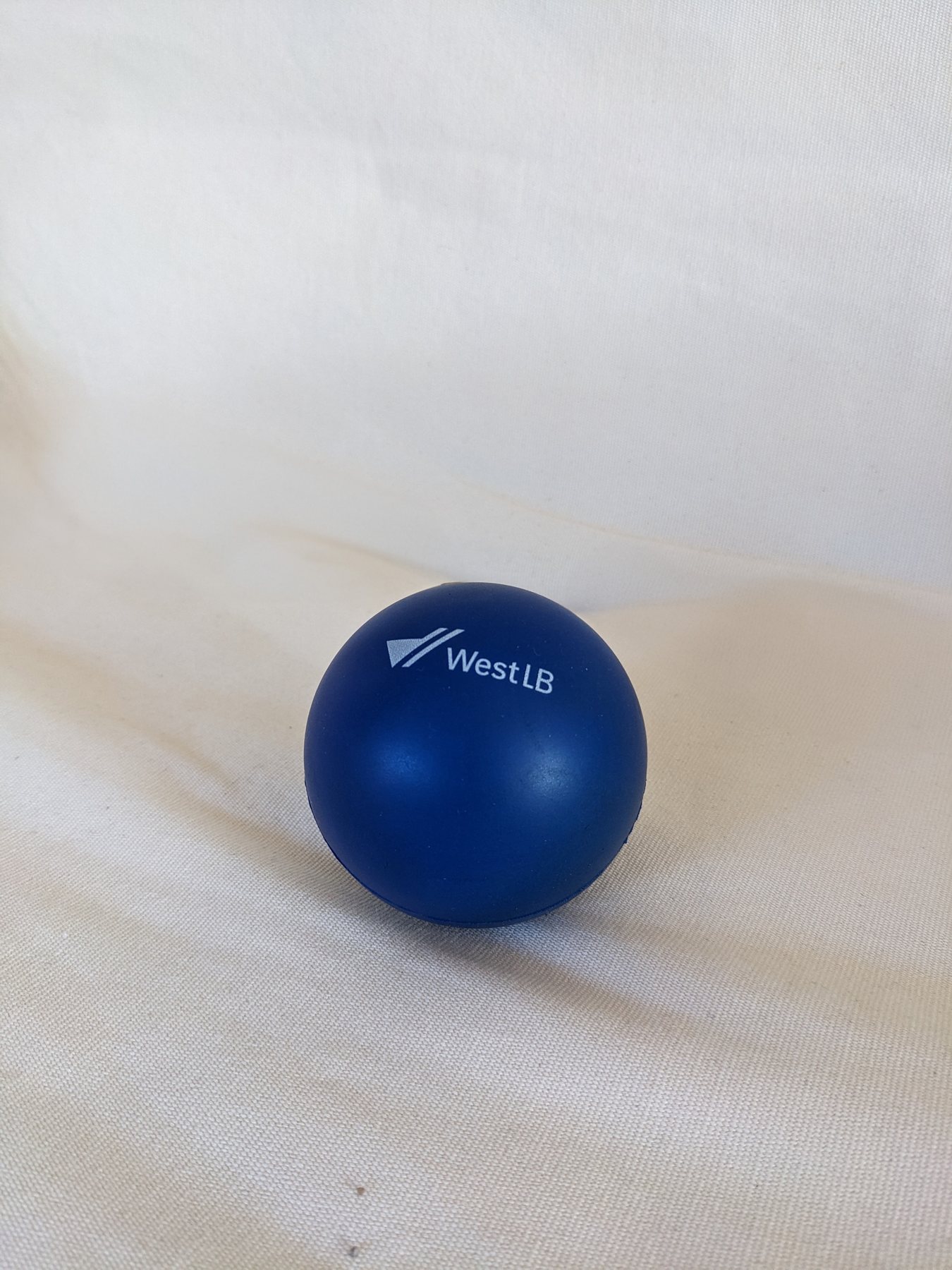
WestLB -> Anti-Stress-Ball, gifted in 2021.
WestLB was a Landesbank: a state-owned wholesale bank, owned by the German state of North Rhine-Westphalia and the regional savings banks. In plain terms, it was owned by the taxpayer. Do hold on to that fact. It becomes funny later – in the way that a root canal is funny.
The pedigree is genuinely wonderful. WestLB traced its lineage to an 1818 reparations payment of 160,000 taler from, of all benefactors, the Swedish government, as compensation to the Prussian province of Westphalia for damage done in the Napoleonic Wars. From this charming seed grew a Westphalian public bank. Its Rhineland sister, the Landesbank der Rheinprovinz, then proceeded to fail spectacularly in the European banking crisis of 1931. So blowing up was, let us say, in the family.
The ambition never matched the temperament. This provincial public bank – formed in 1969 by merging the Rhineland and Westphalian institutions – wanted to play in the same league as Deutsche, Dresdner and Commerzbank, and by the mid-1990s it was indeed Germany’s third-largest bank by balance sheet. It also nurtured a recurring hobby: losing money in ways that required firing people. In 1973 it dropped more than $150 million on unauthorised currency speculation. In 1978 its CEO, Ludwig Poullain, was charged with bribery and fraud over a consulting fee (he was acquitted in 1981). In 2001 Düsseldorf prosecutors found that some DM 15 billion linked to Trans World Group accounts had passed through WestLB and three other big German banks. A real institution.
The London glamour years. From 1998 the American banker Robin Saunders, the darling of the British financial press, ran WestLB’s Principal Finance Group and financed a list that reads like a pub quiz: a bond to refinance Bernie Ecclestone’s Formula One business, the redevelopment of Wembley Stadium, Philip Green’s purchase of BHS, and a humble British television-rental company called Boxclever. Boxclever, alas, marched into administration; WestLB eventually booked a loss of some €427 million on it and posted a group loss of €1.7 billion for 2002. In December 2003 the bank parted company with its star banker. The glamour moved on; the write-downs stayed.
Now, the Volkswagen part – since you asked specifically. In 2007 WestLB’s proprietary traders were caught running clever-clever bets on German “pairs”: positions in ordinary versus preference shares of the same company – VW, BMW and Metro among them – wagering the gap between the two would narrow. The gap did the precise opposite, two traders were dismissed, and the losses grew in instalments, from a first €100 million to a final tally of around €600 million. In July 2007 CEO Thomas Fischer was removed. And here is the punchline that no screenwriter would dare: WestLB was an early casualty of the very VW ordinary-share dynamic that, on 28 October 2008, produced the greatest short squeeze in financial history – when VW briefly topped €1,005 and became, for one delirious afternoon, the most valuable listed company on Earth. WestLB got squeezed by Volkswagen a full year before it was fashionable. Pioneers, really.
Then came 2008 in earnest: structured credit, the toxic confetti that every German Landesbank somehow owned by the bin-bag. A €5 billion guarantee from the owners in February 2008. Then, from January 2010, €77.5 billion of problem assets shovelled into a “bad bank” named, with magnificent bureaucratic poetry, the Erste Abwicklungsanstalt – even the bad bank had a name like a tax form – followed by a further €124 billion in 2012. By one Handelsblatt tally, support from owners and federal government between 2002 and 2012 added up to some €21 billion. Brussels, distinctly unamused by yet another round of state aid, pressed for an end; in June 2011 the owners agreed to break the bank up, and the European Commission signed off in December 2011. On 30 June 2012, WestLB ceased to exist: the savings-bank business went to Helaba, the rest to the bad bank, and the leftover shell became Portigon.
And the grand finale: Cum-Ex. WestLB has been linked to cum-ex dividend-stripping – the scheme in which the state cheerfully refunds a dividend tax it collected only once, or never. Read that slowly: a bank owned by the state, suspected of helping to reclaim a tax the state never actually received.
In 2017 the NRW government confirmed that prosecutors and tax investigators were examining WestLB’s share trades from 2006 to 2011 over suspected multiple refunds of capital-gains tax. The tax bill followed: roughly €1 billion including interest, which Portigon tried to pass on to the bad bank – until the Higher Regional Court in Frankfurt ruled in December 2022 that Portigon had to keep it. So the circle closes: the taxpayer funded WestLB; WestLB lost the taxpayer’s money; the taxpayer bailed it out; and the taxpayer’s own shell company ended up paying the taxpayer back for refunds the taxpayer should never have made. A perfect Möbius strip of public money.
Museum note: the anti-stress ball is the only WestLB asset known to have retained its full value. Squeeze gently – the bank never learned how.
Further reading
- Wikipedia – WestLB (ongoing)
- Wikipedia (German) – WestLB, incl. trading losses and wind-down (ongoing)
- Wikipedia (German) – Erste Abwicklungsanstalt (ongoing)
- Tagesspiegel – Die Fehlspekulationen bei der WestLB und ihre Folgen (2007)
- Wikipedia – Robin Saunders (ongoing)
- Harvard Law School Forum – Evidence from the Volkswagen Short Squeeze (2021)
- Börsen-Zeitung – Portigon bleibt auf Cum-ex-Last sitzen (2022)


