 Jesse Livermore
· 3 min read
Veganz - Every Flower Counts
Exhibit: “Die Bieneninsel – Jede Blume zählt”, a bee-friendly planter kit with the Veganz logo on the box – a recent acquisition.
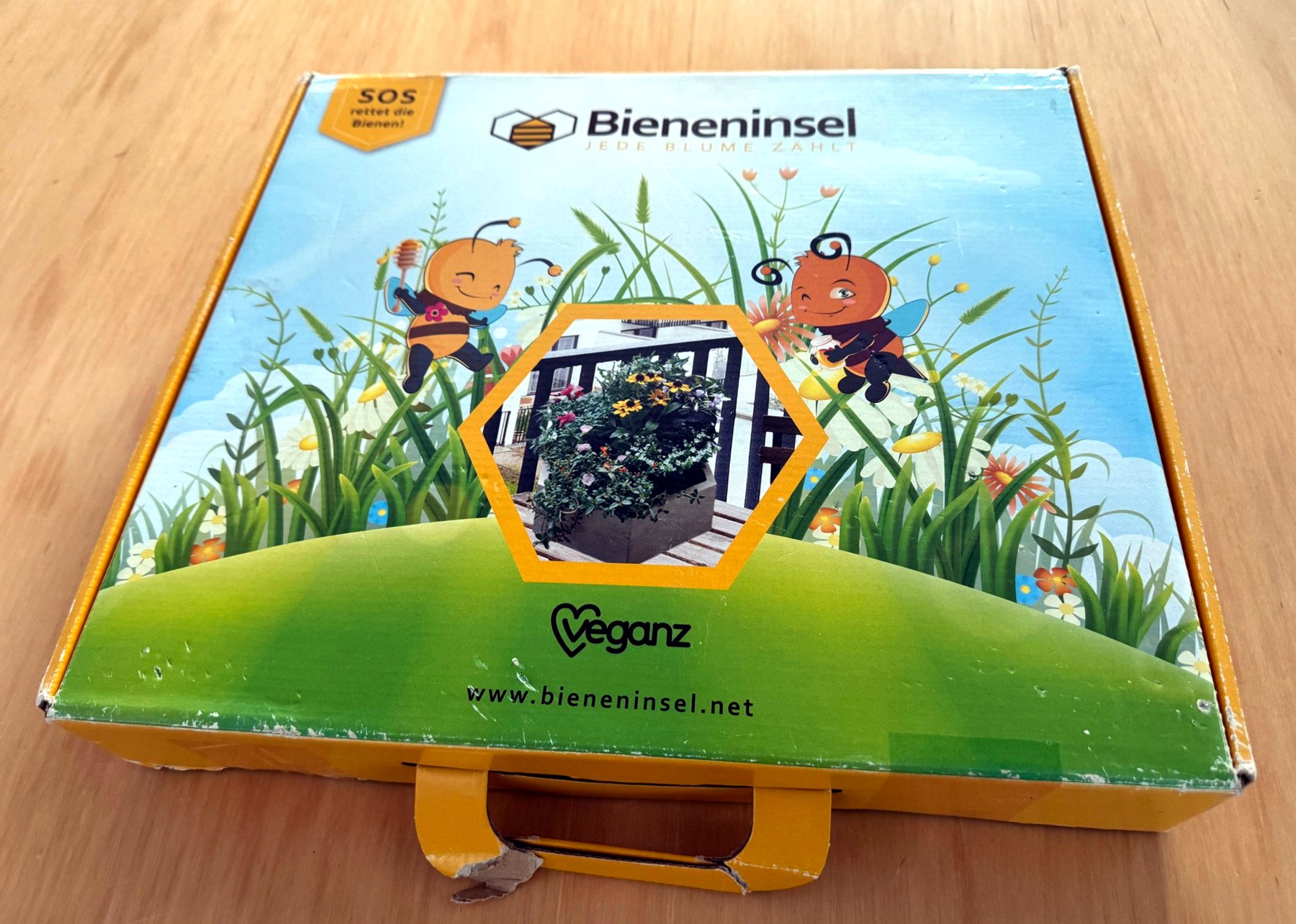
A vegan food company has a delicate problem with bees: it cannot sell their honey. Veganz solved it in May 2021 with admirable logic. For World Bee Day it launched Ohnig – a honey substitute made from tapioca syrup, the name a pun on ohne, “without” – and, as the companion piece, promoted the Bieneninsel, a self-assembly wooden planter with seeds for wild bees, made by a small company of the same name. You eat the fake honey, the real bees get a flower bed. Nobody is exploited. Our exhibit is that kit, Veganz logo on the box, a relic of the company’s most optimistic spring.
Because six months later, Veganz went public. Founded in Berlin by former Mercedes-Benz manager Jan Bredack, it had opened what it called Europe’s first fully vegan supermarket in 2011, expanded across Germany, Austria and Prague, and learned the hard way that a supermarket is a supermarket: the retail arm filed for self-administered insolvency in 2016, and the remaining stores were gradually closed. The group reinvented itself as a brand and food-tech company, and on 10 November 2021 listed in the Scale segment in Frankfurt at €87 a share, near the bottom of the range, raising €33.8 million gross. The first price on Xetra was €83. It never saw the issue price again.
The debt had arrived earlier: a 7.5% bond 2020/2025 of just under €10 million. In February 2025 it was due; the money was not there. After a first bondholder vote failed for lack of quorum, creditors agreed in December 2024 to push maturity out to 2030, with small annual repayments from 2026 extracted by the investor association SdK.
Then came the pivot, or rather several. Mililk: oat milk “printed” as thin 2D sheets, to be dissolved in water at the café, promising a fraction of the transport emissions. OrbiFarm: indoor farming modules developed with the Fraunhofer Institute, sold in June 2025 for €30 million plus an earn-out, payable in instalments – a one-off gain that, according to Wikipedia, was larger than the half-year’s entire reported EBITDA. In August 2025 shareholders approved spinning the brands into subsidiaries, and in September the listed company renamed itself Planethic Group AG, a “technology investment holding” for food concepts. The Veganz brand itself was earmarked for sale. Bredack stepped down as CEO at the end of September 2025 to run OrbiFarm – the business his company had just sold – and the holding then got through three chief executives in about eight weeks.
Revenue meanwhile had fallen three years in a row, to €10.8 million in 2024. On 25 June 2026 the board decided to petition a Berlin court for insolvency in self-administration for the holding company; the subsidiaries are not part of the proceedings, and a bondholder meeting planned for July was cancelled. The shares last traded at around €1.45 in early September 2026 – roughly 98% below the IPO price. As of October 2026, the restructuring of the holding is under way, Mililk’s US plans live on in press releases, and the 2030 bond looks rather less like a bond.
Museum note: the box promises that every flower counts. For the shareholders, alas, so did every euro – and fewer of those were planted where they could grow.
Further reading
- Wikipedia – Veganz (Planethic Group) (ongoing)
- Green Queen – German plant-based pioneer Planethic Group files for self-administration (2026)
- LTO – Goodwin Procter | Noerr: Börsendebüt für Veganz (2021)
- Anleihen Finder – Veganz-Anleihe: SdK stellt Gegenantrag und fordert Anpassungen (2024)
- ECOreporter – Veganz-Anleihe: Gläubiger beschließen Laufzeitverlängerung (2024)
- The Munich Eye – Veganz rebrands and restructures as Planethic Group (2025)
- vegconomist – Bienen retten mit Veganz Ohnig und der Bieneninsel (2021)


