 Jesse Livermore
· 3 min read
The other Louis Vuitton called "Powerland"

Part of the portfolio since 11/2011
Besides Asian Bamboo there were several other Chinese companies with a German listing. Who still remembers those fancy names and business models? Ultrasonic, Kinghero, United Power, Haikui Seafood, Ming Le, Goldrooster, Yubisheng Green Paper, Joyou. All of them failed, some of them spectacularly.
One of those companies was called Powerland. Powerland aspired to become the next Louis Vuitton and claimed to be a leading Chinese maker of handbags and leather goods. Not one of those fake-market knock-off operations – no! A real one!
Its second brand, “Sotto”, was said to be produced in Italy in the same factory as Armani. The bags and purses were sold through a network of more than 100 company-owned stores in China’s big cities, with further distribution in airports and malls; the company also made goods for international brands. Its spring/summer 2012 collection, launched in October 2011 at the Hyatt on the Bund in Shanghai promised a “Sino-Italian” aesthetic. The company was founded by Shunyuan Guo, who remained CEO throughout.
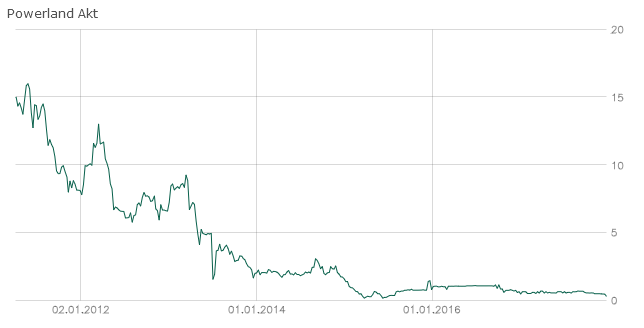
When it hit the market on 11 April 2011 (just before German-listed Chinese companies became an obvious “no go” for everybody) it sold a cool EUR 95mn in shares at EUR 15 – the sixth Chinese IPO on Frankfurt’s regulated market, led by Macquarie with Berenberg alongside. While EUR 75mn went to the company, the remainder was sold by existing shareholders around Guo. As they say: IPO … Insider Public Offering. The market cap was a nice EUR 225mn.
The proceeds were earmarked for a massive expansion into 300 new stores, marketing – and a nice dividend too.
Most of those Chinese companies had several things in common:
1) Pristine balance sheets with plenty of net cash
2) High revenue growth and fat margins
3) Unbelievably high returns on tangible capital
From afar it seemed that all those Chinese companies had hired the same consultant to tell them what a German investor’s wet dream of a fine company would look like.
The first (2011) Annual Report of Powerland, for example, showed
1) +30% revenue growth to EUR 147mn
2) 19.4% EBIT margin and EBIT of EUR 32mn
3) Net cash of EUR 50mn
4) ROCE (EBIT / tangible capital) of a whopping 43%
The stock trading at an EV of EUR 100mn and 3x EBIT? What a no-brainer …
Well, things turned out differently.
In 03/2013 the company had to announce that its annual report would be delayed because of increased scrutiny by the auditor, BDO. At the same time the CFO left with immediate effect – “by mutual agreement”, as these things always are. Always a good start.
A few months later, in 07/2013, the full extent of the mess became clear: BDO refused to sign off on the audit. The ad-hoc announcement is a good read. It spoke of “Prüfungshemmnisse” – obstacles to the audit – and to us it was a clear sign that Powerland’s books could not be trusted. Trade receivables went up and up. The announcement also mentioned that one South African customer had paid USD 800k directly to Shunyuan Guo rather than to the company. In the very same announcement, management and supervisory board decided on a share buyback programme – a marvellous sense of timing, or of humour.
There followed some years as one of the living dead. In 2015 the company announced that it would delist its shares.
Today Powerland and Sotto bags are still being sold, so I guess the business is still alive and kicking. Which makes the shareholders, quite literally, bagholders …
This “emotional short” worked out nicely, with a decline of 100%.
Museum note: in luxury, the brand is everything and the product is a detail. Powerland applied the same principle to its balance sheet.
Further reading
- Deutsche Börse – IPO in Prime Standard: Powerland AG (2011)
- LTO – CMS Hasche Sigle advises on Powerland’s IPO (2011)
- onvista – Powerland ad-hoc: publication of 2012 accounts postponed (2013)
- FashionUnited – Powerland, style sino-italien (2011)
- Kapitalmarkthygienemuseum – Asian Bamboo: growing like a weed
- Wikipedia – Sino-Forest Corporation, the template for Chinese listing scandals (ongoing)


