 Jesse Livermore
· 3 min read
Blue Chip Stamps - the Berkshire Hathaway Story
Part of the portfolio since 2015...
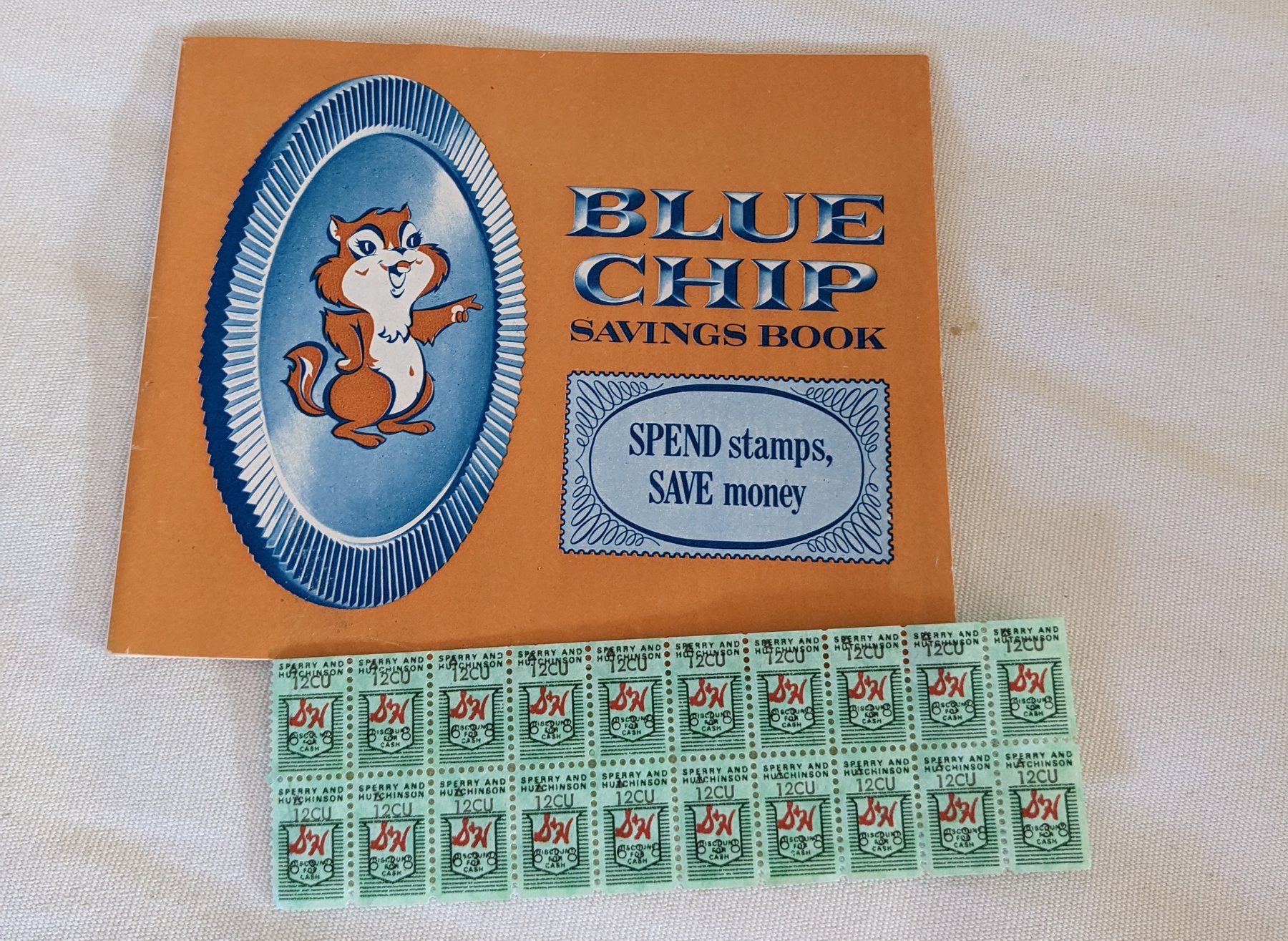
Some exhibits in this museum mark the end of a great company. This one marks the beginning of one. On display: an orange Blue Chip Savings Book with its pointing chipmunk mascot (“Spend stamps, save money”) – and, lying in front of it, a strip of green S&H stamps from the arch-rival Sperry & Hutchinson. Even in a museum, competition never sleeps.
The business. Trading stamps were the loyalty points of post-war America. Shoppers received stamps at the supermarket or petrol station, licked them into booklets and redeemed full books for toasters, lamps and garden furniture. Blue Chip Stamps dominated California; after a US antitrust action begun in 1963, a 1967 consent decree reorganised it into a new, independent company. In 1970 Blue Chip had sales of $126 million – in Warren Buffett's words, its stamps “papered California”.
The trick. Retailers paid for the stamps up front; customers redeemed them months or years later – or never. In between sat a large pool of other people's money: the float. Warren Buffett, Charlie Munger and Berkshire Hathaway began buying in around 1970, Munger later became chairman, and the float started working for owners who knew exactly what to do with it.
What they bought with it. In January 1972 Blue Chip took control of See's Candies, paying $25 million in total for a business earning about $4 million pre-tax on just $8 million of tangible assets. Three times tangible book “made me gulp”, Buffett later admitted – but Munger had persuaded him to stop buying fair businesses at wonderful prices and start buying wonderful businesses at fair prices. By 2014 See's had earned $1.9 billion pre-tax while needing only $40 million of additional capital. In 1977 Blue Chip bought the Buffalo Evening News for about $35.5 million, and it also controlled the savings-and-loan holding company Wesco Financial.
The fade. Meanwhile the stamp business melted away as shoppers and retailers lost their taste for licking and sticking. Sales fell to $19.4 million by 1980 and $1.5 million by 1990. Munger warned shareholders early on that, without new issuance, the float would shrink and with it the investment income. He was right, and it did not matter: the float had long since been turned into See's, the Buffalo News and Wesco. Berkshire raised its stake step by step to 60% and absorbed Blue Chip completely in 1983.
The punchline came in Buffett's 2006 shareholder letter: of Berkshire's $98 billion in revenues that year, Blue Chip contributed $25,920 – “no zeros omitted”. According to Wikipedia, the company still exists and, as of 2024, will redeem a full book for $1.80. Our savings book is not for sale at that price.
Museum note: the lesson of Blue Chip Stamps is that a dying business in the right hands can be a perfectly good seed. The stamps lost almost everything; the float they generated became the cornerstone of Berkshire Hathaway. Collecting the worthless, it turns out, occasionally has a very high terminal value. Do you own any other relics from the early Buffett/Munger years? Tell us via the contact page.
Further reading
- Berkshire Hathaway – Shareholder letter 2014 (50-year review, See's Candies) (2015)
- Berkshire Hathaway – Shareholder letter 2006 (Blue Chip's $25,920) (2007)
- Hedge Fund Alpha – Charlie Munger's Blue Chip Stamps letters 1977–1982 (1977–1982)
- Wikipedia – Blue Chip Stamps (ongoing)
- Wikipedia – See's Candies (ongoing)
- Peter D. Kaufman (ed.) – Poor Charlie's Almanack (2005)
- Berkshire Hathaway – All shareholder letters (1977–today)


